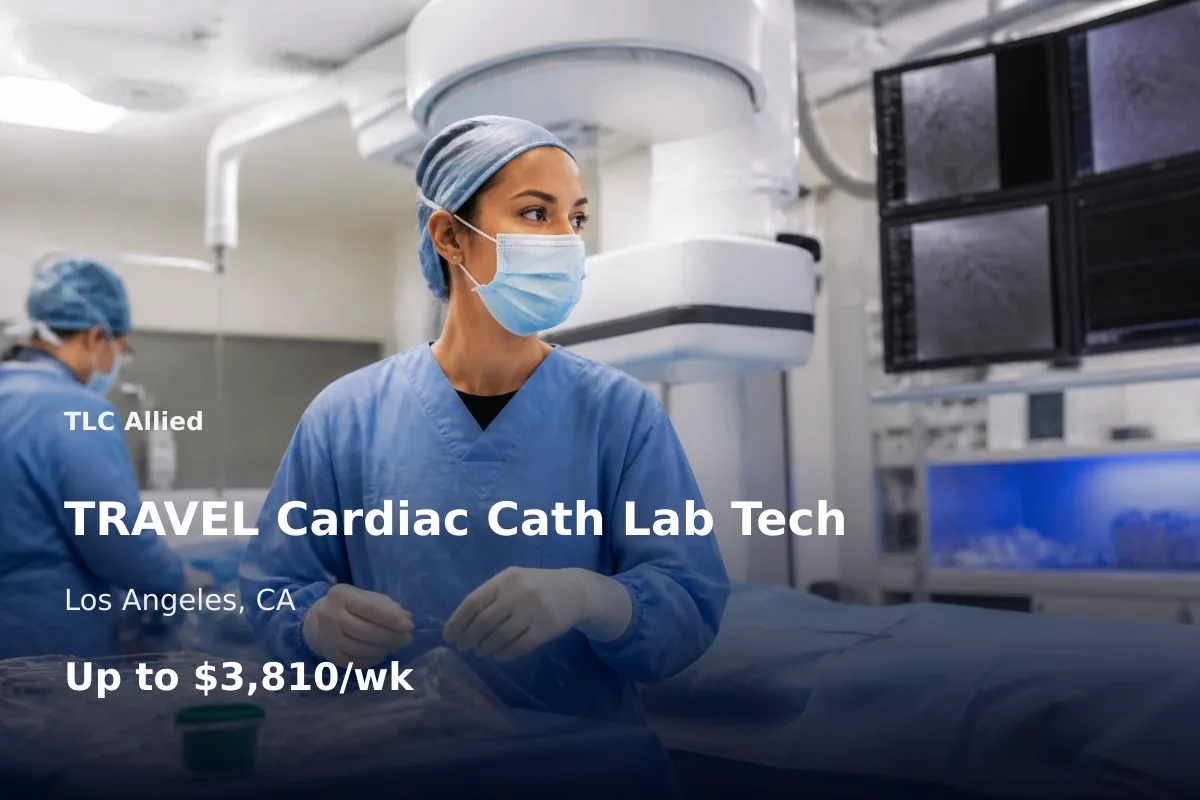
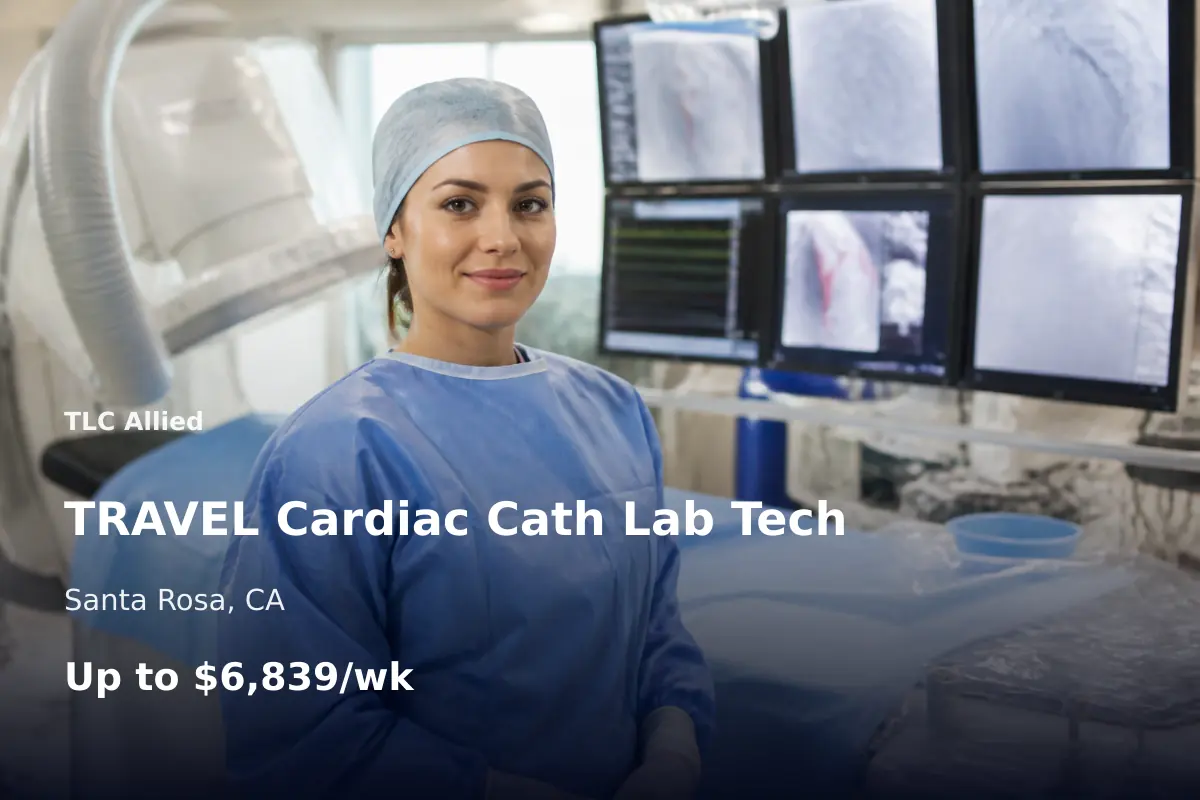
Travel Cardiac Cath Lab Tech Job in Santa Rosa, CA | $6,839/wk
Pay Range: $6162 - 6839$
Quick Apply30 sec application
Pay Range: $5200 - 5771$
Pay Range: $4307 - 4781$
 Kevette Wilson
Pay Range: $4066 - 4513$
Pay Range: $4036 - 4221$
Pay Range: $3621 - 4019$
Pay Range: $3597 - 3992$
Pay Range: $3822 - 3984$
Pay Range: $3565 - 3957$
Pay Range: $3794 - 3949$
Pay Range: $3536 - 3924$
Pay Range: $3524 - 3911$
Pay Range: $3719 - 3904$
Pay Range: $3515 - 3901$
Pay Range: $3497 - 3881$
Pay Range: $3491 - 3875$
Pay Range: $3489 - 3873$
Pay Range: $3682 - 3872$
Pay Range: $3487 - 3870$
Pay Range: $3487 - 3870$
Pay Range: $3481 - 3863$
Pay Range: $3460 - 3840$
Pay Range: $3626 - 3816$
Pay Range: $3658 - 3813$
Pay Range: $3625 - 3810$
Allied health jobs give healthcare professionals a practical way to build meaningful long-term careers across hospitals, clinics, rehabilitation centers, imaging departments, and other healthcare settings. Allied health professionals represent roughly 60% of the healthcare workforce, providing vital diagnostic, therapeutic, and technical support services that help improve patient care every day.
Allied health careers include physical therapist, respiratory therapist, radiologic technologist, medical laboratory scientist, medical assistants, phlebotomists, speech-language pathologists, and many other
...trained professionals. In 2026, allied health professionals work across hospitals, outpatient centers, home health, schools, emergency medicine, rehabilitation, imaging, and telehealth.
Most allied health careers do not require medical school, though education and licensing requirements vary significantly by specialty. Allied health jobs are generally divided into technicians/assistants who perform procedures with 1-2 years of training, and technologists/therapists who diagnose, evaluate, and create treatment plans.
This guide covers travel allied health jobs, permanent positions, per diem shifts, salaries, certifications, healthcare staffing agencies, and future career development.
Allied health means non-physician, non-nursing clinical and technical careers that support diagnoses, treatments, rehabilitation, safety, and quality patient care.
The same allied health career can be structured in different ways. A CT technologist may take a 13-week travel contract in one city, accept a permanent hospital position, or work per diem weekends.
Travel allied health jobs usually run 8–13 weeks, often with housing, meals, travel stipends, and possible sign on bonus offers. Permanent allied health jobs provide stability, supervision, benefits, and long-term team connection. Per diem allied health roles fill staffing gaps and give professionals flexible schedules.
Examples include a travel MRI technologist rotating through California and Texas, a permanent occupational therapist in a rehab hospital, or a diem respiratory therapist picking up ICU night shifts.
Travel demand grew after 2020 because hospitals needed faster staffing for seasonal census, vacancies, rural access, cath lab, ICU, and interventional radiology. Common travel specialties include imaging, respiratory, surgical technology, medical laboratory science, physical and occupational therapy, and pharmacy technology.
Typical contracts include:
Weekly gross pay often exceeds staff pay, especially in high-need markets, but exact rates depend on location, shift, specialty, and contract terms.
| Pros | Cons |
| Higher earning potential | Frequent relocation |
| Exposure to advanced technology | Variable orientation |
| Rapid skill growth | Multiple licenses |
| Tax-advantaged stipends when compliant | Housing stress |
| Access to trauma centers and interventional radiology suites | Harder with pets, families, or roots |
Permanent allied health careers fit professionals who want predictable income, consistent patients, and stronger relationships with nurses, physicians, therapists, and employees. Allied health professionals often receive a comprehensive benefits package that includes medical, dental, and vision coverage, retirement savings plans, paid time off, tuition assistance, wellness resources, and professional development opportunities.
Many allied health organizations emphasize the importance of providing resources and support for career development, enabling professionals to grow in their roles and enhance their skills. A radiologic technologist may specialize in CT or interventional radiology; a respiratory therapist may move into education; a physical therapist may become a rehab manager.
Per diem roles are shift-based jobs covering weekends, holidays, call-ins, and census spikes. Allied health careers can offer flexible work schedules, allowing professionals to balance their personal and professional lives more effectively, which is a significant benefit in the healthcare field.
Per diem work may pay more hourly than staff jobs, but it usually has fewer benefits and no guaranteed hours. It works well for a radiation therapist covering vacations, a PRN speech-language pathologist in skilled nursing, or a respiratory therapist cross-trained for ICU and emergency medicine.
Healthcare occupations are projected to grow much faster than the average for all occupations, driven by an aging global population and a rising prevalence of chronic conditions. The field of allied health professions offers robust job security, rapid career growth, and diverse pathways outside of traditional medicine and nursing.
Physical therapists and assistants develop treatment plans to improve mobility, reduce pain, and restore function for patients of all ages. Settings include outpatient orthopedics, sports medicine, home health, skilled nursing, and inpatient rehab.
Occupational therapists help patients regain daily living skills; occupational therapists have a median annual salary of $98,340, with the highest-paying jobs typically found in nursing care facilities.
Imaging professionals combine technology and patient care. They position patients, ensure radiation safety, communicate clearly, and assist radiologists or surgeons. Interventional radiology technologists help with minimally invasive procedures, contrast injections, and image-guided treatments.
A dosimetrist is a healthcare professional who provides radiation therapy treatment and planning for cancer patients, calculating appropriate doses of radiation to treat cancerous growths. The median annual salary for medical dosimetrists is reported to be $138,110, with expectations for this figure to increase in the future as demand for these professionals grows.
Qualifications for allied health roles vary significantly by specialty and are generally divided into two main tracks: Technicians/Assistants and Therapists/Technologists.
| Role | Education | Credential or license |
| Radiologic technologist | Associate | ARRT, state rules |
| Respiratory therapist | Associate; many prefer bachelor’s | NBRC, state license |
| Medical lab scientist | Bachelor’s | ASCP often preferred |
| Physical therapist | Doctoral | State license |
| Occupational therapist | Master’s or doctoral | State license |
| Speech-language pathologist | Bachelor’s plus master’s | Exam and state license |
Most states require respiratory therapists to obtain at least an associate degree in respiratory therapy, although many employers prefer candidates with bachelor’s degrees. To work as a speech-language pathologist, you need to obtain a bachelor’s degree followed by a master’s degree, and all states require licensure by passing an exam. To become a physician assistant, you must obtain a bachelor’s degree in a related field and then earn a master’s degree, typically requiring some patient care experience beforehand.
Choose a specialty by matching your interests to the work: technology, hands-on care, lab precision, fast-paced acute care, or long-term rehab. Shadow professionals, review accredited programs, compare board pass rates, and evaluate clinical rotation quality before enrolling.
Pay varies by specialty, experience, shift, city, certifications, union status, and whether the job is travel, permanent, or per diem.
| Specialty | Staff annual range | Travel weekly range | Pay boosters |
| Physical therapist | $75k–$100k+ | $2,000–$2,700 | Home health, neuro |
| Radiologic technologist | $70k–$80k | $2,000–$3,000 | CT, MRI, call |
| Respiratory therapist | $60k–$80k+ | $2,200–$2,900 | ICU, nights |
| SLP | $75k–$100k+ | Varies | Schools, SNF |
| Dosimetrist | $138,110 median | Premium niche | Oncology planning |
Higher pay usually comes from experience, specialty certifications, nights, weekends, on-call work, advanced practice, leadership, high-acuity units, and hard-to-fill markets. Large health systems and academic hospitals may offer stronger compensation packages than small facilities.
Career opportunities in allied health include diverse clinical and administrative tracks, with professional development achieved through specialization, leadership roles, and cross-training. Professionals can move into quality, informatics, management, education, or advanced specialty practice.
Stay current with CEUs, EHR skills, digital tools, telehealth rules, equipment updates, and professional associations. Speech-language pathologists evaluate and treat individuals with language, voice, speech, or fluency problems, and they often work in educational institutions, hospitals, or private practices.
Any trained non-physician, non-nursing role supporting diagnosis, treatment, rehabilitation, or technical care.
Most run 8–13 weeks with weekly hours, stipends, credentialing, and possible extensions.
Yes, if your license, certifications, and clinical experience match facility needs.
Dosimetry, advanced imaging, therapy leadership, and specialized acute care roles often pay well.
Often yes, though compacts may improve mobility for some professions.
Renewal varies by board and typically includes continuing education.
Yes, but housing, school schedules, pets, and support systems matter.
They are non-taxed only when IRS rules and tax-home requirements are met.
Transparency, responsiveness, clinical support, and clear contract language.
Specialize, cross-train, lead projects, teach, or pursue advanced education.